
Arun Khetarpal: Difference between revisions
Chief Editor (talk | contribs) Created page with "{{Heading1|title=सेकेंड लेफ्टिनेंट श्री अरुण खेत्रपाल, पीवीसी (बलिदानोपरांत)}} '''Arun Khetarpal''', PVC (14 October 1950 – 16 December 1971) was an Indian armyofficer and a Tank commander, who is recognized as the Indian tank ace of aces, credited with 10 confirmed tank kills. A posthumous recipient of India's highest military decoration, the Param Vir Chakra, which he..." |
Chief Editor (talk | contribs) No edit summary |
||
| (2 intermediate revisions by the same user not shown) | |||
| Line 1: | Line 1: | ||
{{Heading1|title=सेकेंड लेफ्टिनेंट | {{Heading1|title=सेकेंड लेफ्टिनेंट अरुण खेत्रपाल, पीवीसी (बलिदानोपरांत)}} | ||
'''Arun Khetarpal''', PVC (14 October 1950 – 16 December 1971) was an Indian armyofficer and a Tank commander, who is recognized as the Indian tank ace of aces, credited with 10 confirmed tank kills. A posthumous recipient of India's highest military decoration, the Param Vir Chakra, which he was awarded for his valour in face of the enemy. He was killed in action in the Battle of Basantarduring the Indo-Pakistan War of 1971 where his actions earned him the PVC. | '''Arun Khetarpal''', PVC (14 October 1950 – 16 December 1971) was an Indian armyofficer and a Tank commander, who is recognized as the Indian tank ace of aces, credited with 10 confirmed tank kills. A posthumous recipient of India's highest military decoration, the Param Vir Chakra, which he was awarded for his valour in face of the enemy. He was killed in action in the Battle of Basantarduring the Indo-Pakistan War of 1971 where his actions earned him the PVC. | ||
=== Early life === | === Early life === | ||
{{Template1|image2=Indian Army.png|image=Arun_Khetarpal_PVC.jpg|name=2nd Lt | {{Template1|image2=Indian Army.png|image=Arun_Khetarpal_PVC.jpg|name=2nd Lt Arun Khetarpal|title1=PVC (Posthumous)|title2=Maharashtra, Bharat|Service No=IC-25067|Date of Birth=14 October 1950|Place of birth=Pune, Maharashtra|Service=Indian Army|Last Rank=2nd Lieutenant|Unit=17th Poona Horse|Martyrdom=16 December 1971 (aged 21) {{!}} Barapind, Punjab, Pakistan}}Arun Khetarpal was born in Pune, Maharashtra on 14 October 1950 to a Punjabi Hindu Khatri family.His family belonged to Sargodha in western Punjab and had migrated to India after partition as refugees. | ||
[[File:Param Vir Chakra.png|left|frameless|233x233px]] | [[File:Param Vir Chakra.png|left|frameless|233x233px]] | ||
His father Lt Col (later Brigadier) M. L. Khetarpal was an officer serving in the Indian Army's Corps of Engineers. His family traced a long history of military service, with his grandfather having fought in WW1and great-grandfather having served in the Sikh Khalsa Army. | |||
Attending St. Columba's School, Delhi and The Lawrence School, Sanawar, he distinguished himself both as an able student and sportsman and was the school prefect. Khetarpal joined the National Defence Academy in June 1967. He belonged to Foxtrot Squadron where he was the Squadron Cadet Captain of the 38th Course. Under his watch, Foxtrot Squadron became the champions. His NDA No was 7498/F/38. He subsequently went on to join the Indian Military Academy. In his final term at the Indian Military Academy, he was given the privilege of carrying the President's colours. On 13 June 1971, Khetarpal was commissioned into the 17 Poona Horse. | Attending St. Columba's School, Delhi and The Lawrence School, Sanawar, he distinguished himself both as an able student and sportsman and was the school prefect. Khetarpal joined the National Defence Academy in June 1967. He belonged to Foxtrot Squadron where he was the Squadron Cadet Captain of the 38th Course. Under his watch, Foxtrot Squadron became the champions. His NDA No was 7498/F/38. He subsequently went on to join the Indian Military Academy. In his final term at the Indian Military Academy, he was given the privilege of carrying the President's colours. On 13 June 1971, Khetarpal was commissioned into the 17 Poona Horse. | ||
| Line 14: | Line 14: | ||
=== Battle of Basantar === | === Battle of Basantar === | ||
Among the tasks set for the 47th Brigade was to establish a bridgehead across the River Basantar. By 21:00 hours on 15 December, the brigade had captured its objectives. However, the area was extensively mined, which prevented the early deployment of the tanks of the Poona Horse, and the engineers clearing the mines were only halfway through their work when Indian troops at the bridge-head reported heavy and alarming enemy armour movement, requesting immediate armour support. At this critical juncture, the 17 Poona Horse decided to push through the minefield despite the risks. The regiment successfully linked up with the infantry at the bridge-head by first light the following day.[ | Among the tasks set for the 47th Brigade was to establish a bridgehead across the River Basantar. By 21:00 hours on 15 December, the brigade had captured its objectives. However, the area was extensively mined, which prevented the early deployment of the tanks of the Poona Horse, and the engineers clearing the mines were only halfway through their work when Indian troops at the bridge-head reported heavy and alarming enemy armour movement, requesting immediate armour support. At this critical juncture, the 17 Poona Horse decided to push through the minefield despite the risks. The regiment successfully linked up with the infantry at the bridge-head by first light the following day. | ||
[[File:Arun Khetarpal11.png|thumb|2nd Lt Arun Khetarpal as a kid]] | |||
Several modern defence reports — notably a detailed field account published by *ThePrint* — document the presence and contribution of Sowar Parag (Prayag) Singh, Sowar Nand Singh and Sowar Nathu Singh of Hodson’s Horse (4th Horse), who were operating in coordination with the troop that included 2nd Lt. Arun Khetarpal during this phase of the battle. According to these accounts, Parag Singh relayed real-time enemy tank movement, terrain visibility and positional cues that assisted Khetarpal’s crew in making rapid engagement decisions as Pakistani Patton tanks attempted multiple thrusts toward the newly established bridgehead. | Several modern defence reports — notably a detailed field account published by *ThePrint* — document the presence and contribution of Sowar Parag (Prayag) Singh, Sowar Nand Singh and Sowar Nathu Singh of Hodson’s Horse (4th Horse), who were operating in coordination with the troop that included 2nd Lt. Arun Khetarpal during this phase of the battle. According to these accounts, Parag Singh relayed real-time enemy tank movement, terrain visibility and positional cues that assisted Khetarpal’s crew in making rapid engagement decisions as Pakistani Patton tanks attempted multiple thrusts toward the newly established bridgehead. | ||
The same reports note that Sowar Nand Singh and Sowar Nathu Singh, operating in adjacent supporting tanks, maintained coordinated fire and relayed movement cues while holding their positions under heavy shelling. Their contributions, alongside those of Parag Singh, formed part of the broader armoured resistance that enabled Khetarpal’s troop to counter repeated enemy armour assaults. All three crewmen continued to provide supporting fire and battlefield assessments until their tanks were disabled by direct hits during the height of the battle. Although their actions do not appear prominently in official citations, independent war correspondence identifies Parag Singh, Nand Singh and Nathu Singh as “unsung crewmen” whose efforts contributed to stabilising the situation during the engagement. | The same reports note that Sowar Nand Singh and Sowar Nathu Singh, operating in adjacent supporting tanks, maintained coordinated fire and relayed movement cues while holding their positions under heavy shelling. Their contributions, alongside those of Parag Singh, formed part of the broader armoured resistance that enabled Khetarpal’s troop to counter repeated enemy armour assaults. All three crewmen continued to provide supporting fire and battlefield assessments until their tanks were disabled by direct hits during the height of the battle. Although their actions do not appear prominently in official citations, independent war correspondence identifies Parag Singh, Nand Singh and Nathu Singh as “unsung crewmen” whose efforts contributed to stabilising the situation during the engagement. | ||
[[File:Arun Khetarpal18.png|thumb|350x350px|The parents of 2nd Lt Arun Khetarpal, Brig M.L. Khetarpal and Mrs Maheshwari Khetarpal]] | |||
=== Unsung crew members === | === Unsung crew members === | ||
| Line 24: | Line 25: | ||
According to these reports, Parag Singh provided rapid assessments of enemy tank positions, visibility conditions and local terrain, which contributed to the situational awareness of the troop. Sowar Nand Singh and Sowar Nathu Singh, operating in adjacent supporting tanks, are noted for maintaining coordinated fire, relaying movement cues and holding their positions under intense incoming fire as Pakistani armour attempted multiple thrusts toward the bridgehead. | According to these reports, Parag Singh provided rapid assessments of enemy tank positions, visibility conditions and local terrain, which contributed to the situational awareness of the troop. Sowar Nand Singh and Sowar Nathu Singh, operating in adjacent supporting tanks, are noted for maintaining coordinated fire, relaying movement cues and holding their positions under intense incoming fire as Pakistani armour attempted multiple thrusts toward the bridgehead. | ||
[[File:Arun Khetarpal09.png|thumb|285x285px|2nd Lt Arun Khetarpal during his childhood days ...with parents and younger brother Mukesh]] | |||
The report notes that all three crewmen continued their support roles until their tanks were disabled by direct hits during the height of the battle. Although their actions do not appear prominently in official gallantry citations, independent war correspondence places Parag Singh, Nand Singh and Nathu Singh among the “unsung crewmen” whose efforts formed an integral component of the broader armoured resistance at Basantar. | The report notes that all three crewmen continued their support roles until their tanks were disabled by direct hits during the height of the battle. Although their actions do not appear prominently in official gallantry citations, independent war correspondence places Parag Singh, Nand Singh and Nathu Singh among the “unsung crewmen” whose efforts formed an integral component of the broader armoured resistance at Basantar. | ||
=== Bridge-head === | === Bridge-head === | ||
At 08:00 hours on 16th December, Pakistani armour launched the first of their counter-attacks under the cover of a smokescreen at the pivot of the 17th Poona Horse at Jharpal. At 08:00 hours, the Pakistani 13th Lancers, equipped with the then state-of-the-art US-made 50 ton Patton tanks, launched the first of their counter-attacks under the cover of a smokescreen at 'B' Squadron, The Poona Horse, at Jharpal. Its squadron commander urgently called for reinforcements. Arun Khetarpal, who was in 'A' squadron and was stationed close by with his Centurion tank troops, responded with alacrity, as did the rest of his regiment. The first counter-attack was decimated by accurate gunnery, coolness by Indian tank troops and individual tank commanders from the CO, Lt Col Hanut Singhdown to its troop leader, Arun Khetarpal. The 13th Lancers desperately launched two more squadron-level counter-attacks and managed to achieve a breakthrough. | At 08:00 hours on 16th December, Pakistani armour launched the first of their counter-attacks under the cover of a smokescreen at the pivot of the 17th Poona Horse at Jharpal. At 08:00 hours, the Pakistani 13th Lancers, equipped with the then state-of-the-art US-made 50 ton Patton tanks, launched the first of their counter-attacks under the cover of a smokescreen at 'B' Squadron, The Poona Horse, at Jharpal. Its squadron commander urgently called for reinforcements. Arun Khetarpal, who was in 'A' squadron and was stationed close by with his Centurion tank troops, responded with alacrity, as did the rest of his regiment. The first counter-attack was decimated by accurate gunnery, coolness by Indian tank troops and individual tank commanders from the CO, Lt Col Hanut Singhdown to its troop leader, Arun Khetarpal. The 13th Lancers desperately launched two more squadron-level counter-attacks and managed to achieve a breakthrough. | ||
[[File:Arun Kheterpal.jpg|thumb|389x389px|Relief Mural at Balidan Stambh, Jammu]] | |||
Khetarpal rushed to meet the Pakistani armour and launched right into the Pakistani attack. With his troop, he was able to run over the enemy advance with his tanks. However, the commander of the second tank was killed in this attack. Alone in the charge, Khetarpal continued his attack on the enemy strongholds. Disappointed by his failure so far, he desperately attacked the incoming Pakistani troops and tanks, knocking out a Pakistani tank in the process. However Pakistani forces regrouped and counter-attacked. In the ensuing tank battle, Lt. Arun Khetarpal with his 2 remaining tanks bravely fought off and destroyed 10 Pakistani Patton tanks before he was shot and killed in action. | Khetarpal rushed to meet the Pakistani armour and launched right into the Pakistani attack. With his troop, he was able to run over the enemy advance with his tanks. However, the commander of the second tank was killed in this attack. Alone in the charge, Khetarpal continued his attack on the enemy strongholds. Disappointed by his failure so far, he desperately attacked the incoming Pakistani troops and tanks, knocking out a Pakistani tank in the process. However Pakistani forces regrouped and counter-attacked. In the ensuing tank battle, Lt. Arun Khetarpal with his 2 remaining tanks bravely fought off and destroyed 10 Pakistani Patton tanks before he was shot and killed in action. | ||
| Line 43: | Line 44: | ||
Arun Khetarpal's body was cremated on 17 December near Samba district and his ashes were sent to his family, who were unaware of his death until 26 December. | Arun Khetarpal's body was cremated on 17 December near Samba district and his ashes were sent to his family, who were unaware of his death until 26 December. | ||
The crew of the ''Famagusta'' was Sowar Prayag Singh (the driver), Sowar Nand Singh (the radio operator), Sowar Nathu Singh (the gunner) and 2nd/Lt. Arun Khetarpal, the tank's commander. Nand Singh was first casualty (killed in action; KIA) when the tank was fatally hit in the final encounter with Pakistani Army Major Nasser's Patton tank. Arun was the second one to be killed after he sustained severe injuries when his tank was knocked out and eventually succumbed to his wounds. Both Prayag Singh and Nathu Singh were also badly wounded but survived and were captured by Pakistani troops who seized the ''Famagusta''. | The crew of the ''Famagusta'' was Sowar Prayag Singh (the driver), Sowar Nand Singh (the radio operator), Sowar Nathu Singh (the gunner) and 2nd/Lt. Arun Khetarpal, the tank's commander. Nand Singh was first casualty (killed in action; KIA) when the tank was fatally hit in the final encounter with Pakistani Army Major Nasser's Patton tank. Arun was the second one to be killed after he sustained severe injuries when his tank was knocked out and eventually succumbed to his wounds. Both Prayag Singh and Nathu Singh were also badly wounded but survived and were captured by Pakistani troops who seized the ''Famagusta''. | ||
=== Param Vir Chakra Citation === | === Param Vir Chakra Citation === | ||
| Line 55: | Line 56: | ||
Second Lieutenant Arun Khetarpal had shown the best qualities of leadership, tenacity of purpose and the will to close in with the enemy. This was an act of courage and self-sacrifice far beyond the call of duty.</blockquote> | Second Lieutenant Arun Khetarpal had shown the best qualities of leadership, tenacity of purpose and the will to close in with the enemy. This was an act of courage and self-sacrifice far beyond the call of duty.</blockquote> | ||
[[File:Arun Khetarpal08.png|thumb|450x450px|2nd Lt Khetarpal's tank]] | |||
=== Legacy === | === Legacy === | ||
| Line 60: | Line 62: | ||
The Commander of the Pakistan tank battalion is said to have met the Indian battalion commander after the battle and made enquiries about 2nd Lieutenant Khetarpal's tank since he was very impressed with the gallantry of this particular tank's commander. | The Commander of the Pakistan tank battalion is said to have met the Indian battalion commander after the battle and made enquiries about 2nd Lieutenant Khetarpal's tank since he was very impressed with the gallantry of this particular tank's commander. | ||
[[File:Arun Khetarpal07.png|thumb|2nd Lt Khetarpal's tank]] | |||
In 2001, Brigadier M. L. Khetarpal – then 81 years old – felt a strong desire to visit his birthplace at Sargodha, now in Pakistan. At Lahore airport, Brigadier M. L. Khetarpal was met by Brigadier Khwaja Mohammad Naser, who took it upon himself to be Brigadier M.L. Khetarpal's host and guide. Brigadier Naser really went out of way to ensure Brigadier M.L. Khetarpal had a satisfying and nostalgic visit to his old house in Sargodha. Upon his return to Lahore he was once again the guest of Brigadier Naser for three days. | In 2001, Brigadier M. L. Khetarpal – then 81 years old – felt a strong desire to visit his birthplace at Sargodha, now in Pakistan. At Lahore airport, Brigadier M. L. Khetarpal was met by Brigadier Khwaja Mohammad Naser, who took it upon himself to be Brigadier M.L. Khetarpal's host and guide. Brigadier Naser really went out of way to ensure Brigadier M.L. Khetarpal had a satisfying and nostalgic visit to his old house in Sargodha. Upon his return to Lahore he was once again the guest of Brigadier Naser for three days. | ||
| Line 80: | Line 82: | ||
* Allu Sirish reprised Arun Khetarpal's character as Lt Chinmay in the 2017 Malayalam film 1971: Beyond Borders. | * Allu Sirish reprised Arun Khetarpal's character as Lt Chinmay in the 2017 Malayalam film 1971: Beyond Borders. | ||
* A biopic on Arun Khetarpal is being directed by Sriram Raghavan displaying his courage in the 1971 Battle of Basantar. Actor Varun Dhawan was slated to play the lead role in the film, but was no longer a part of it by 2022. It was later announced actor Agastya Nanda would be playing the role of the protagonist and the film would be titled ''Ikkis'' (the Hindi word for 21, the age at which Khetarpal achieved martyrdom), with Dharmendra playing the role of his father, Brigadier M. L. Khetarpal. | * A biopic on Arun Khetarpal is being directed by Sriram Raghavan displaying his courage in the 1971 Battle of Basantar. Actor Varun Dhawan was slated to play the lead role in the film, but was no longer a part of it by 2022. It was later announced actor Agastya Nanda would be playing the role of the protagonist and the film would be titled ''Ikkis'' (the Hindi word for 21, the age at which Khetarpal achieved martyrdom), with Dharmendra playing the role of his father, Brigadier M. L. Khetarpal. | ||
[[File:Hoshiar-Singh.jpg|center|thumb|950x950px|Khetarpal's statue at ''Param Yodha Sthal'', National War Memorial, New Delhi]] | |||
== सेकंड लेफ्टिनेंट '''अरुण खेत्रपाल''' , परमवीर चक्र (बलिदानोपरांत) == | |||
'''17 हॉर्स (पूना हॉर्स) | भारतीय सेना''' | |||
'''1971 भारत–पाक युद्ध के सबसे युवा और प्रेरक वीर योद्धाओं में एक''' | |||
'''सेकंड लेफ्टिनेंट अरुण खेत्रपाल''' भारतीय सैन्य इतिहास के उन अमर नायकों में हैं, जिनका नाम 1971 के भारत–पाक युद्ध की '''बसंतर नदी (शकरगढ़ सेक्टर)''' की भीषण टैंक लड़ाई के साथ सदा के लिए जुड़ गया। मात्र '''21 वर्ष''' की आयु में, अत्यंत प्रतिकूल परिस्थितियों में, अपने टैंक को आग की लपटों में घिरा देखकर भी उन्होंने युद्धभूमि नहीं छोड़ी और अंतिम श्वास तक शत्रु से लोहा लेते हुए सर्वोच्च बलिदान दिया। उनके इसी '''अद्वितीय शौर्य, अदम्य युद्ध-आत्मा और कर्तव्यनिष्ठा''' के लिए उन्हें '''परमवीर चक्र (मरणोपरांत)''' से सम्मानित किया गया। | |||
=== प्रारंभिक जीवन एवं पारिवारिक पृष्ठभूमि === | |||
अरुण खेत्रपाल का जन्म '''14 अक्टूबर 1950''' को '''पुणे, महाराष्ट्र''' में एक प्रतिष्ठित सैन्य परिवार में हुआ। वे '''ब्रिगेडियर एम. एल. खेत्रपाल''' के सुपुत्र थे। परिवार की कई पीढ़ियाँ सेना से जुड़ी रही थीं—उनके दादा प्रथम विश्व युद्ध में ब्रिटिश सेना में और परदादा सिख सेना में रहे थे। | |||
उन्होंने '''लॉरेंस स्कूल, सनावर (हिमाचल प्रदेश)''' में शिक्षा प्राप्त की, जहाँ वे पढ़ाई के साथ-साथ खेलों में भी उत्कृष्ट रहे। नेतृत्व क्षमता के कारण वे सहपाठियों में विशेष सम्मान पाते थे। | |||
=== सैन्य प्रशिक्षण एवं कमीशन === | |||
'''जून 1967''' में वे '''राष्ट्रीय रक्षा अकादमी (NDA)''' के '''38वें कोर्स''' में चयनित हुए और '''फॉक्सट्रॉट स्क्वाड्रन''' के '''स्क्वाड्रन कैडेट कैप्टन''' बने। इसके बाद '''भारतीय सैन्य अकादमी (IMA), देहरादून''' से प्रशिक्षण पूर्ण कर उन्हें '''13 जून 1971''' को '''17 हॉर्स (पूना हॉर्स)''' में कमीशन प्राप्त हुआ। | |||
कमीशन के केवल '''छह माह''' बाद ही उन्हें युद्धभूमि में उतरना पड़ा। | |||
=== 1971 का भारत–पाक युद्ध: बसंतर की ऐतिहासिक टैंक लड़ाई === | |||
1971 के युद्ध में '''17 हॉर्स''' को '''शकरगढ़ सेक्टर''' में बसंतर नदी पार कर बनाए गए ब्रिजहेड की रक्षा और विस्तार का दायित्व सौंपा गया। यह युद्ध आधुनिक भारतीय सैन्य इतिहास की '''सबसे भीषण टैंक लड़ाइयों''' में से एक माना जाता है। | |||
'''16 दिसंबर 1971''' को पाकिस्तानी सेना ने टैंकों के एक पूरे स्क्वाड्रन के साथ '''जर्पाल''' क्षेत्र में ज़ोरदार पलटवार किया। | |||
* जब भारतीय टुकड़ियाँ संख्या में कम पड़ने लगीं, तो सेकंड लेफ्टिनेंट अरुण खेत्रपाल ने '''स्वेच्छा से आगे बढ़कर''' सहायता का निर्णय लिया। | |||
* मार्ग में उन्होंने शत्रु की मज़बूत पैदल और रीकॉयललेस गन पोस्टों पर '''सीधे धावा बोलकर''' उन्हें निष्क्रिय किया और शत्रु सैनिकों को '''पिस्तौल की नोक पर बंदी''' बनाया। | |||
* इसके बाद उन्होंने आगे बढ़कर शत्रु के टैंकों का पीछा किया और '''एक टैंक नष्ट''' किया। | |||
* शीघ्र ही एक और भीषण टैंक युद्ध छिड़ गया, जिसमें '''दस पाकिस्तानी टैंक''' नष्ट हुए—'''चार टैंक स्वयं अरुण खेत्रपाल ने ध्वस्त किए'''। | |||
* इस दौरान उनका टैंक '''आग की लपटों में घिर गया''' और वे '''गंभीर रूप से घायल''' हो गए। | |||
* उन्हें टैंक छोड़ने का आदेश दिया गया, किंतु उन्होंने यह समझते हुए कि ऐसा करने से शत्रु को ब्रेकथ्रू मिल जाएगा, '''आदेश मानने से इनकार कर दिया'''। | |||
* जलते हुए टैंक में रहते हुए उन्होंने '''एक और शत्रु टैंक नष्ट किया''', इससे पहले कि उनका टैंक दूसरी बार हिट हो और वे वीरगति को प्राप्त हों। | |||
उनके इस सर्वोच्च बलिदान ने शत्रु के आक्रमण को निर्णायक रूप से विफल कर दिया और भारतीय विजय सुनिश्चित की। | |||
=== परमवीर चक्र === | |||
सेकंड लेफ्टिनेंट अरुण खेत्रपाल को '''अत्यंत विशिष्ट वीरता, अदम्य साहस और कर्तव्य से परे जाकर किए गए सर्वोच्च बलिदान''' के लिए '''परमवीर चक्र (मरणोपरांत)''' प्रदान किया गया। वे परमवीर चक्र प्राप्त करने वाले '''सबसे युवा सैनिकों''' में से एक हैं। | |||
=== स्मारक, सम्मान एवं विरासत === | |||
* '''राष्ट्रीय युद्ध स्मारक, नई दिल्ली''' के ''परम योद्धा स्थल'' पर उनकी बस्ट। | |||
* '''राष्ट्रीय रक्षा अकादमी (NDA)''' का परेड ग्राउंड '''“खेत्रपाल ग्राउंड”''' उनके नाम पर। | |||
* '''भारतीय सैन्य अकादमी (IMA)''' में सभागार एवं मुख्य द्वार उनके नाम पर। | |||
* उनका '''सेंट्यूरियन टैंक “फामागुस्ता”''' आज '''आर्मर्ड कॉर्प्स सेंटर एंड स्कूल, अहमदनगर''' में संरक्षित है। | |||
* '''सनावर (लॉरेंस स्कूल)''' में उनकी जीवन-आकार प्रतिमा और स्टेडियम उनके नाम पर। | |||
सेकंड लेफ्टिनेंट अरुण खेत्रपाल का जीवन यह सिद्ध करता है कि '''वीरता उम्र की मोहताज नहीं होती'''। जलते टैंक में बैठकर अंतिम सांस तक लड़ना—यह केवल युद्धक कौशल नहीं, बल्कि '''कर्तव्य, नेतृत्व और राष्ट्रप्रेम''' की चरम अभिव्यक्ति है। | |||
उनकी गाथा आने वाली पीढ़ियों के लिए भारतीय सेना के आदर्श वाक्य को साकार करती है— | |||
'''“सेवा परमो धर्मः।”'''<gallery mode="packed"> | |||
File:Arun Khetarpal04.png|Khetrapal Parade Ground in National Defence Academy, Pune. | |||
File:Arun Khetarpal19.png|Khetarpal Family in Sikkim | |||
File:Arun Khetarpal17.png|2nd Lt Arun Khetarpal's bust at National Defence Academy, Pune. | |||
File:Arun Khetarpal16.png|2nd Lt Arun Khetarpal's samadhi at Kaluchak which has now been shifted to Pathankot | |||
File:Arun Khetarpal15.png|2nd Lt Arun Khetarpal...during his training days in NDA | |||
File:Arun Khetarpal14.png|2nd Lt Arun Khetarpa during his training days in NDA | |||
File:Arun Khetarpal13.png|2nd Lt Arun Khetarpal during his training days in NDA | |||
File:Arun Khetarpal12.png|2nd Lt Arun Khetarpal during his training in NDA | |||
File:Arun Khetarpal10.png|2nd Lt Arun Khetarpal was a very good Saxophone player and was part of the band in NDA | |||
File:Arun Khetarpal06.png|The stadium at Lawrence School in Sanawar is named after him. His legacy lives on. | |||
File:Arun Khetarpal05.png|2nd Lt Arun Khetarpal as a young boy standing behind his younger brother Mukesh | |||
File:Arun Khetarpal03.png|2nd Lt Arun Khetarpal with his brother Mukesh in Sanawar | |||
</gallery> | |||
[[Category:Indian Army]] | |||
[[Category:Param Vir Chakra]] | |||
[[Category:Maharashtra]] | |||
[[Category:Poona Horse]] | |||
[[Category:17 Poona Horse.]] | |||
Latest revision as of 02:25, 13 January 2026
सेकेंड लेफ्टिनेंट अरुण खेत्रपाल, पीवीसी (बलिदानोपरांत)
Arun Khetarpal, PVC (14 October 1950 – 16 December 1971) was an Indian armyofficer and a Tank commander, who is recognized as the Indian tank ace of aces, credited with 10 confirmed tank kills. A posthumous recipient of India's highest military decoration, the Param Vir Chakra, which he was awarded for his valour in face of the enemy. He was killed in action in the Battle of Basantarduring the Indo-Pakistan War of 1971 where his actions earned him the PVC.
Early life
| 2nd Lt Arun Khetarpal | |
|---|---|
| PVC (Posthumous) | |
 | |
| Maharashtra, Bharat | |
| Service No | IC-25067 |
| Date of Birth | 14 October 1950 |
| Place of birth | Pune, Maharashtra |
| Service | Indian Army |
| Last Rank | 2nd Lieutenant |
| Unit | 17th Poona Horse |
| Martyrdom | 16 December 1971 (aged 21) | Barapind, Punjab, Pakistan |
 | |
Arun Khetarpal was born in Pune, Maharashtra on 14 October 1950 to a Punjabi Hindu Khatri family.His family belonged to Sargodha in western Punjab and had migrated to India after partition as refugees.

His father Lt Col (later Brigadier) M. L. Khetarpal was an officer serving in the Indian Army's Corps of Engineers. His family traced a long history of military service, with his grandfather having fought in WW1and great-grandfather having served in the Sikh Khalsa Army.
Attending St. Columba's School, Delhi and The Lawrence School, Sanawar, he distinguished himself both as an able student and sportsman and was the school prefect. Khetarpal joined the National Defence Academy in June 1967. He belonged to Foxtrot Squadron where he was the Squadron Cadet Captain of the 38th Course. Under his watch, Foxtrot Squadron became the champions. His NDA No was 7498/F/38. He subsequently went on to join the Indian Military Academy. In his final term at the Indian Military Academy, he was given the privilege of carrying the President's colours. On 13 June 1971, Khetarpal was commissioned into the 17 Poona Horse.
1971 War
During the Indo-Pakistan War of 1971, the 17 Poona Horse was assigned to the command of the 47th Infantry Brigade of the Indian Army. Through the duration of the conflict, the 47th Brigade saw action in the Shakargarh sector in the Battle of Basantar.
Battle of Basantar
Among the tasks set for the 47th Brigade was to establish a bridgehead across the River Basantar. By 21:00 hours on 15 December, the brigade had captured its objectives. However, the area was extensively mined, which prevented the early deployment of the tanks of the Poona Horse, and the engineers clearing the mines were only halfway through their work when Indian troops at the bridge-head reported heavy and alarming enemy armour movement, requesting immediate armour support. At this critical juncture, the 17 Poona Horse decided to push through the minefield despite the risks. The regiment successfully linked up with the infantry at the bridge-head by first light the following day.

Several modern defence reports — notably a detailed field account published by *ThePrint* — document the presence and contribution of Sowar Parag (Prayag) Singh, Sowar Nand Singh and Sowar Nathu Singh of Hodson’s Horse (4th Horse), who were operating in coordination with the troop that included 2nd Lt. Arun Khetarpal during this phase of the battle. According to these accounts, Parag Singh relayed real-time enemy tank movement, terrain visibility and positional cues that assisted Khetarpal’s crew in making rapid engagement decisions as Pakistani Patton tanks attempted multiple thrusts toward the newly established bridgehead.
The same reports note that Sowar Nand Singh and Sowar Nathu Singh, operating in adjacent supporting tanks, maintained coordinated fire and relayed movement cues while holding their positions under heavy shelling. Their contributions, alongside those of Parag Singh, formed part of the broader armoured resistance that enabled Khetarpal’s troop to counter repeated enemy armour assaults. All three crewmen continued to provide supporting fire and battlefield assessments until their tanks were disabled by direct hits during the height of the battle. Although their actions do not appear prominently in official citations, independent war correspondence identifies Parag Singh, Nand Singh and Nathu Singh as “unsung crewmen” whose efforts contributed to stabilising the situation during the engagement.

Unsung crew members
Independent veteran testimonies and recent defence reportage highlight the contributions of several lesser-known tank crewmen who supported the armoured operations during the Battle of Basantar. Modern accounts identify Sowar Parag (Prayag) Singh, Sowar Nand Singh and Sowar Nathu Singh of Hodson’s Horse (4th Horse) among the soldiers who played significant operational roles alongside the troop that included 2nd Lt. Arun Khetarpal during the critical stages of the engagement.
According to these reports, Parag Singh provided rapid assessments of enemy tank positions, visibility conditions and local terrain, which contributed to the situational awareness of the troop. Sowar Nand Singh and Sowar Nathu Singh, operating in adjacent supporting tanks, are noted for maintaining coordinated fire, relaying movement cues and holding their positions under intense incoming fire as Pakistani armour attempted multiple thrusts toward the bridgehead.

The report notes that all three crewmen continued their support roles until their tanks were disabled by direct hits during the height of the battle. Although their actions do not appear prominently in official gallantry citations, independent war correspondence places Parag Singh, Nand Singh and Nathu Singh among the “unsung crewmen” whose efforts formed an integral component of the broader armoured resistance at Basantar.
Bridge-head
At 08:00 hours on 16th December, Pakistani armour launched the first of their counter-attacks under the cover of a smokescreen at the pivot of the 17th Poona Horse at Jharpal. At 08:00 hours, the Pakistani 13th Lancers, equipped with the then state-of-the-art US-made 50 ton Patton tanks, launched the first of their counter-attacks under the cover of a smokescreen at 'B' Squadron, The Poona Horse, at Jharpal. Its squadron commander urgently called for reinforcements. Arun Khetarpal, who was in 'A' squadron and was stationed close by with his Centurion tank troops, responded with alacrity, as did the rest of his regiment. The first counter-attack was decimated by accurate gunnery, coolness by Indian tank troops and individual tank commanders from the CO, Lt Col Hanut Singhdown to its troop leader, Arun Khetarpal. The 13th Lancers desperately launched two more squadron-level counter-attacks and managed to achieve a breakthrough.

Khetarpal rushed to meet the Pakistani armour and launched right into the Pakistani attack. With his troop, he was able to run over the enemy advance with his tanks. However, the commander of the second tank was killed in this attack. Alone in the charge, Khetarpal continued his attack on the enemy strongholds. Disappointed by his failure so far, he desperately attacked the incoming Pakistani troops and tanks, knocking out a Pakistani tank in the process. However Pakistani forces regrouped and counter-attacked. In the ensuing tank battle, Lt. Arun Khetarpal with his 2 remaining tanks bravely fought off and destroyed 10 Pakistani Patton tanks before he was shot and killed in action.
Death
The skirmish however took its toll on the lieutenant as he was hit by enemy fire, but instead of abandoning the tank, he fought on, thus destroying one final tank before he was finally overwhelmed. However, his actions had denied a vital breakthrough for Pakistani forces and instead put the Indians in a stronger position in the Shakargarh bulge. His final words over the radio to a superior officer who had ordered him to abandon his burning tank were,
"No, Sir, I will not abandon my tank. My main gun is still working and I will get these bastards."
— Arun Khetarpal
Then he set about destroying the remaining enemy tanks. The last enemy tank which he shot was barely 100 metres from his position. At this stage, his tank received a second hit and he was seriously injured. The officer met his death trying to deny the Pakistani Army its desired breakthrough.
Khetarpal's body and his tank, named "Famagusta", were later captured by Pakistan and eventually returned to the Indian military. This tank is on display in India now.
For his conspicuous bravery and extreme gallantry in the face of fierce and unrelenting attacks and assaults by the enemy (the Pakistani military), Khetarpal was honoured with India's most-prestigious and highest-standard military medal for courage and gallantry, the Param Vir Chakra, posthumously.
Arun Khetarpal's body was cremated on 17 December near Samba district and his ashes were sent to his family, who were unaware of his death until 26 December.
The crew of the Famagusta was Sowar Prayag Singh (the driver), Sowar Nand Singh (the radio operator), Sowar Nathu Singh (the gunner) and 2nd/Lt. Arun Khetarpal, the tank's commander. Nand Singh was first casualty (killed in action; KIA) when the tank was fatally hit in the final encounter with Pakistani Army Major Nasser's Patton tank. Arun was the second one to be killed after he sustained severe injuries when his tank was knocked out and eventually succumbed to his wounds. Both Prayag Singh and Nathu Singh were also badly wounded but survived and were captured by Pakistani troops who seized the Famagusta.
Param Vir Chakra Citation
The Param Vir Chakra citation on the Official Indian Army Website reads as follows:
CITATION
SECOND LIEUTENANT ARUN KHETARPAL POONAHORSE (IC-25067)
On 16 December 1971, the Squadron Commander of 'B' Squadron, the Poona Horse asked for reinforcement as the Pakistani Armour which was superior in strength, counter attacked at Jarpal, in the Shakargarh Sector. On hearing this transmission, Second Lieutenant Arun Khetarpal who was in 'A' Squadron, voluntarily moved along with his troops, to assist the other squadron. En route, while crossing the Basantar river, Second Lieutenant Arun Khetarpal and his troops came under fire from enemy strong points and RCL gun nests that were still holding out. Time was at a premium and as critical situation was developing in the 'B' Squadron sector, Lieutenant Arun Khetarpal, threw caution to the winds and started attacking the impending enemy strong points by literally charging them, overrunning the defence works with his tanks and capturing the enemy infantry and weapon crew at pistol point. In commander of his troop was killed. Second Lieutenant Arun Khetarpal continued to attack relentlessly until all enemy opposition was overcome and he broke through towards the 'B' Squadron position, just in time to see the enemy tanks pulling back after their initial probing attack on this squadron. He was so carried away by the wild enthusiasm of battle and the impetus of his own headlong dash that he started chasing the withdrawing tanks and even managed to shoot and destroy one. Soon thereafter, the enemy reformed with a squadron of armour for a second attack and this time they selected the sector held by Second Lieutenant Arun Khetarpal and two other tanks as the points for their main effort. A fierce tank fight ensured ten enemy tanks were hit and destroyed of which Second Lieutenant Arun Khetarpal was severely wounded. He was asked to abandon his tank but he realised that the enemy though badly decimated was continuing to advance in his sector of responsibility and if he abandoned his tank the enemy would break through, he gallantly fought on and destroyed another enemy tank. At this stage, his tank received a second hit which resulted in the death of this gallant officer.
Second Lieutenant Arun Khetarpal was dead but he had, by his intrepid valour saved the day; the enemy was denied the breakthrough he was so desperately seeking. Not one enemy tank got through.
Second Lieutenant Arun Khetarpal had shown the best qualities of leadership, tenacity of purpose and the will to close in with the enemy. This was an act of courage and self-sacrifice far beyond the call of duty.

Legacy
Balidan Stambh, the war memorial in Jammu in 2009 paid tribute to him by inscribing his name on the pillars erected in semi circumference for the martyrs of the 1971 war. His name is displayed near the eternal flame and as relief mural on the semi circumference wall with the Param Vir Chakra awardees who attained martyrdom in Jammu and Kashmir.
"The only occasion when a breakthrough could have occurred was when two squadrons of 13 Lancers attacked together in the afternoon, but a gallant last ditch lone stand by 2/Lt Arun Khetarpal of Poona Horse averted the danger."
— Maj AH Amin (Retd) (Pakistan Armoured Corps – Columnist and Historian)
The Commander of the Pakistan tank battalion is said to have met the Indian battalion commander after the battle and made enquiries about 2nd Lieutenant Khetarpal's tank since he was very impressed with the gallantry of this particular tank's commander.

In 2001, Brigadier M. L. Khetarpal – then 81 years old – felt a strong desire to visit his birthplace at Sargodha, now in Pakistan. At Lahore airport, Brigadier M. L. Khetarpal was met by Brigadier Khwaja Mohammad Naser, who took it upon himself to be Brigadier M.L. Khetarpal's host and guide. Brigadier Naser really went out of way to ensure Brigadier M.L. Khetarpal had a satisfying and nostalgic visit to his old house in Sargodha. Upon his return to Lahore he was once again the guest of Brigadier Naser for three days.
Brigadier M. L. Khetarpal was overwhelmed by the extreme kindness, deference, courtesy and respect bestowed upon him by Brigadier Naser and by all the members of his family and his many servants. However Brigadier Khetarpal felt something was amiss but could not make out what it was. Was it the long silences that punctuated their animated conversation or was it the look of compassion in the eyes of the women in the family? He could not make out but was sure he was being treated as someone very special.
Finally, on the last night before Brigadier M.L. Khetarpal's departure, Brigadier Naser said
Sir, there is something that I wanted to tell you for many years but I did not know how to get through to you. Finally, fate has intervened and sent you to me as an honoured guest. The last few days we have become close to one another and that has made my task even more difficult. It is regarding your son who is, of course, a national hero in India. However, on that fateful day, your son and I were soldiers, unknown to one another, fighting for the respect and safety of our respective countries. I regret to tell you that your son died in my hands. Arun's courage was exemplary and he moved his tank with fearless courage and daring, totally unconcerned about his safety. Tank casualties were very high till finally there were just two of us left facing one another. We both fired simultaneously. It was destined that I was to live and he was to die. It was only later that I got to know how young he was and who he was.I had all along thought that I would ask your forgiveness, but in telling the story I realize that there is nothing to forgive. Instead I salute your son for what he did at such a young age and I salute you too, because I know how he grew into such a young man. In the end it is character and values that matter."
Brigadier M. L. Khetarpal was silent as he did not know how to react. To be enjoying the hospitality of the person who had killed his son was a confusing feeling. However being a soldier himself he genuinely admired the chivalry of an officer whose complete squadron was decimated by his son. Both the Brigadiers retired for the night deep in thought. The next day photographs were taken and Brigadier M. L. Khetarpal returned to Delhi. Later the photos reached Delhi along with a note from Brigadier Naser that said:
"With Warmest regards and utmost sincerity, To: Brigadier M.L. Khetarpal, father of Shaheed Second Lieutenant Arun Khetarpal, PVC, who stood like an unsurmountable rock, between the victory and failure, of the counterattack by the 'SPEARHEADS' 13 LANCERS on 16 December 1971 in the battle of "Bara Pind' as we call it and battle of "Basantar" as 17 Poona Horse remembers.
— --Khawja Mohammad Naser, 13 Lancers, 2 March 2001, Lahore, Pakistan.
Khetrapal is an iconic figure in the ethos of the Indian Army with prominent constructions being named after him. The parade ground at NDA is named Khetarpal Ground while the auditorium and one of the main gates bear his name at the IMA.
His Centurion tank was called Famagusta Jx 202. It was restored after the war and is presently preserved in the Armoured Corps Centre and School in Ahmednagar.
In popular culture
- The fourteenth episode on DD National of the Param Vir Chakra TV series reprised his character in 1988.
- A graphic novel titled Param Vir Chakra by Amar Chitra Katha dedicated their fourteenth story written by Sanjana Kapur and drawn by Arijit Dutta Chowdhury in 2015.
- A graphic novel titled Param Vir Chakra Arun Khetarpal by Roli Books written by Ian Cardozo and drawn by Rishi Kumar in 2019.
- Allu Sirish reprised Arun Khetarpal's character as Lt Chinmay in the 2017 Malayalam film 1971: Beyond Borders.
- A biopic on Arun Khetarpal is being directed by Sriram Raghavan displaying his courage in the 1971 Battle of Basantar. Actor Varun Dhawan was slated to play the lead role in the film, but was no longer a part of it by 2022. It was later announced actor Agastya Nanda would be playing the role of the protagonist and the film would be titled Ikkis (the Hindi word for 21, the age at which Khetarpal achieved martyrdom), with Dharmendra playing the role of his father, Brigadier M. L. Khetarpal.

सेकंड लेफ्टिनेंट अरुण खेत्रपाल , परमवीर चक्र (बलिदानोपरांत)
17 हॉर्स (पूना हॉर्स) | भारतीय सेना
1971 भारत–पाक युद्ध के सबसे युवा और प्रेरक वीर योद्धाओं में एक
सेकंड लेफ्टिनेंट अरुण खेत्रपाल भारतीय सैन्य इतिहास के उन अमर नायकों में हैं, जिनका नाम 1971 के भारत–पाक युद्ध की बसंतर नदी (शकरगढ़ सेक्टर) की भीषण टैंक लड़ाई के साथ सदा के लिए जुड़ गया। मात्र 21 वर्ष की आयु में, अत्यंत प्रतिकूल परिस्थितियों में, अपने टैंक को आग की लपटों में घिरा देखकर भी उन्होंने युद्धभूमि नहीं छोड़ी और अंतिम श्वास तक शत्रु से लोहा लेते हुए सर्वोच्च बलिदान दिया। उनके इसी अद्वितीय शौर्य, अदम्य युद्ध-आत्मा और कर्तव्यनिष्ठा के लिए उन्हें परमवीर चक्र (मरणोपरांत) से सम्मानित किया गया।
प्रारंभिक जीवन एवं पारिवारिक पृष्ठभूमि
अरुण खेत्रपाल का जन्म 14 अक्टूबर 1950 को पुणे, महाराष्ट्र में एक प्रतिष्ठित सैन्य परिवार में हुआ। वे ब्रिगेडियर एम. एल. खेत्रपाल के सुपुत्र थे। परिवार की कई पीढ़ियाँ सेना से जुड़ी रही थीं—उनके दादा प्रथम विश्व युद्ध में ब्रिटिश सेना में और परदादा सिख सेना में रहे थे।
उन्होंने लॉरेंस स्कूल, सनावर (हिमाचल प्रदेश) में शिक्षा प्राप्त की, जहाँ वे पढ़ाई के साथ-साथ खेलों में भी उत्कृष्ट रहे। नेतृत्व क्षमता के कारण वे सहपाठियों में विशेष सम्मान पाते थे।
सैन्य प्रशिक्षण एवं कमीशन
जून 1967 में वे राष्ट्रीय रक्षा अकादमी (NDA) के 38वें कोर्स में चयनित हुए और फॉक्सट्रॉट स्क्वाड्रन के स्क्वाड्रन कैडेट कैप्टन बने। इसके बाद भारतीय सैन्य अकादमी (IMA), देहरादून से प्रशिक्षण पूर्ण कर उन्हें 13 जून 1971 को 17 हॉर्स (पूना हॉर्स) में कमीशन प्राप्त हुआ।
कमीशन के केवल छह माह बाद ही उन्हें युद्धभूमि में उतरना पड़ा।
1971 का भारत–पाक युद्ध: बसंतर की ऐतिहासिक टैंक लड़ाई
1971 के युद्ध में 17 हॉर्स को शकरगढ़ सेक्टर में बसंतर नदी पार कर बनाए गए ब्रिजहेड की रक्षा और विस्तार का दायित्व सौंपा गया। यह युद्ध आधुनिक भारतीय सैन्य इतिहास की सबसे भीषण टैंक लड़ाइयों में से एक माना जाता है।
16 दिसंबर 1971 को पाकिस्तानी सेना ने टैंकों के एक पूरे स्क्वाड्रन के साथ जर्पाल क्षेत्र में ज़ोरदार पलटवार किया।
- जब भारतीय टुकड़ियाँ संख्या में कम पड़ने लगीं, तो सेकंड लेफ्टिनेंट अरुण खेत्रपाल ने स्वेच्छा से आगे बढ़कर सहायता का निर्णय लिया।
- मार्ग में उन्होंने शत्रु की मज़बूत पैदल और रीकॉयललेस गन पोस्टों पर सीधे धावा बोलकर उन्हें निष्क्रिय किया और शत्रु सैनिकों को पिस्तौल की नोक पर बंदी बनाया।
- इसके बाद उन्होंने आगे बढ़कर शत्रु के टैंकों का पीछा किया और एक टैंक नष्ट किया।
- शीघ्र ही एक और भीषण टैंक युद्ध छिड़ गया, जिसमें दस पाकिस्तानी टैंक नष्ट हुए—चार टैंक स्वयं अरुण खेत्रपाल ने ध्वस्त किए।
- इस दौरान उनका टैंक आग की लपटों में घिर गया और वे गंभीर रूप से घायल हो गए।
- उन्हें टैंक छोड़ने का आदेश दिया गया, किंतु उन्होंने यह समझते हुए कि ऐसा करने से शत्रु को ब्रेकथ्रू मिल जाएगा, आदेश मानने से इनकार कर दिया।
- जलते हुए टैंक में रहते हुए उन्होंने एक और शत्रु टैंक नष्ट किया, इससे पहले कि उनका टैंक दूसरी बार हिट हो और वे वीरगति को प्राप्त हों।
उनके इस सर्वोच्च बलिदान ने शत्रु के आक्रमण को निर्णायक रूप से विफल कर दिया और भारतीय विजय सुनिश्चित की।
परमवीर चक्र
सेकंड लेफ्टिनेंट अरुण खेत्रपाल को अत्यंत विशिष्ट वीरता, अदम्य साहस और कर्तव्य से परे जाकर किए गए सर्वोच्च बलिदान के लिए परमवीर चक्र (मरणोपरांत) प्रदान किया गया। वे परमवीर चक्र प्राप्त करने वाले सबसे युवा सैनिकों में से एक हैं।
स्मारक, सम्मान एवं विरासत
- राष्ट्रीय युद्ध स्मारक, नई दिल्ली के परम योद्धा स्थल पर उनकी बस्ट।
- राष्ट्रीय रक्षा अकादमी (NDA) का परेड ग्राउंड “खेत्रपाल ग्राउंड” उनके नाम पर।
- भारतीय सैन्य अकादमी (IMA) में सभागार एवं मुख्य द्वार उनके नाम पर।
- उनका सेंट्यूरियन टैंक “फामागुस्ता” आज आर्मर्ड कॉर्प्स सेंटर एंड स्कूल, अहमदनगर में संरक्षित है।
- सनावर (लॉरेंस स्कूल) में उनकी जीवन-आकार प्रतिमा और स्टेडियम उनके नाम पर।
सेकंड लेफ्टिनेंट अरुण खेत्रपाल का जीवन यह सिद्ध करता है कि वीरता उम्र की मोहताज नहीं होती। जलते टैंक में बैठकर अंतिम सांस तक लड़ना—यह केवल युद्धक कौशल नहीं, बल्कि कर्तव्य, नेतृत्व और राष्ट्रप्रेम की चरम अभिव्यक्ति है।
उनकी गाथा आने वाली पीढ़ियों के लिए भारतीय सेना के आदर्श वाक्य को साकार करती है—
“सेवा परमो धर्मः।”
-
 Khetrapal Parade Ground in National Defence Academy, Pune.
 -
 Khetarpal Family in Sikkim
 -
 2nd Lt Arun Khetarpal's bust at National Defence Academy, Pune.
 -
 2nd Lt Arun Khetarpal's samadhi at Kaluchak which has now been shifted to Pathankot
 -
 2nd Lt Arun Khetarpal...during his training days in NDA
 -
 2nd Lt Arun Khetarpa during his training days in NDA
 -
 2nd Lt Arun Khetarpal during his training days in NDA
 -
 2nd Lt Arun Khetarpal during his training in NDA
 -
 2nd Lt Arun Khetarpal was a very good Saxophone player and was part of the band in NDA
 -
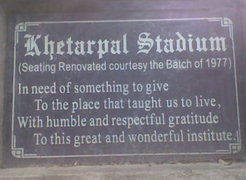 The stadium at Lawrence School in Sanawar is named after him. His legacy lives on.
 -
 2nd Lt Arun Khetarpal as a young boy standing behind his younger brother Mukesh
 -
 2nd Lt Arun Khetarpal with his brother Mukesh in Sanawar


